
How to check your anti-virus is working or not using anti-malware testfile?

Say, you want to test your anti-virus program on your PC. Using real viruses for testing in the real world is rather like setting fire to the dustbin in your office to see whether the smoke detector is working. Such a test will give meaningful results, but with unappealing, unacceptable risks.

Since it is unacceptable for you to send out real viruses for test or demonstration purposes, you need a file that can safely be passed around and which is obviously non-viral, but which your anti-virus software will react to as if it were a virus.


The good news is that such a test file already exists. A number of anti-virus researchers have already worked together to produce a file that their (and many other) products "detect" as if it were a virus.

It's called EICAR.COM anti malware testfile. It is also short and simple - in fact, it consists entirely of printable ASCII characters, so that it can easily be created with a regular text editor.

So, without any further ado, lets get down to brass tacks.

Step 1: Open Notepad.

Step 2: Type this string without quotes:
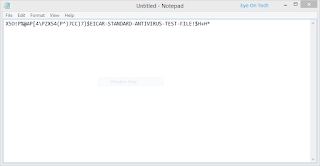
"X5O!P%@AP[4\PZX54(P^)7CC)7}$EICAR-STANDARD-ANTIVIRUS-TEST-FILE!$H+H*"


Step 3: Save it as "eicar.com" (crucial to save it with .com extention).


Now you will see the testfile detected by your antivirus program as malicious.


If not detected, your anti-virus is not working. That's all.

Comments

Popular posts from this blog

Best Gaming Laptops You Can Buy Right Now

Gaming Laptops are no joke. They pack some serious performance under the hood that even some mid-range desktops cannot match. They’re often considered as huge, heavy and fat machines with red and blue paint all over their chassis, but that’s not the case at present. Over the past few years, manufacturers have introduced laptops packing more and more power in a thinner and lighter chassis. If you take a look at a gaming laptop from ten years ago and compare to anything from the present, I can guarantee that your jaw will drop and you’ll start wondering how technology has improved over the decade. Here are the top 10 performance grade laptops to make your selection from. 1. ASUS ROG G701VI Gaming Laptop  Unlocked Intel i7-7820HK processor 64GB of DDR4 RAM (yes, you read that right!) 1 TB NVMe SSD Overclockable GTX 1080 desktop class graphics card 17.3-inch 120Hz Full HD IPS panel with NVIDIA G-Sync 2. Alienware 17 R4 Intel i7-7820HK processor (overclocked up to 4.4 GHz) 32GB of DDR4 ...

Top macOS Mojave Features

At WWDC today (June 4), Apple's Senior Vice President Craig Federighi revealed a lot of new Mac features, and a new name. Yes, macOS 11.14 Mojave is coming to users this fall. Highlights of this new, free update include a universal dark mode, a dynamic desktop, a Finder that photographers will love and a version of Safari with even more privacy-focused tools than before. Apple also improved screenshots in ways that iPhone and iPad users will find familiar. Oh, and Apple announced the baby steps its taking to bring iOS apps to the Mac, including four of its own titles -- Apple News, Stocks, Voice Memos and Home. Dark Mode This feature allows you to take all of the user interfaces in your Mac's apps, and turn them from bright to dark hues. Federighi said apps really pop against a white background, and while I'm inclined to believe him, I'm mostly happy to have a native feature that means my eyes will be hit with less bright light. Dynamic Desktop For th...

How to verify your downloaded files using MD5 Checksum on Windows?

MD5 stands for Message Digest version 5 . The MD5 algorithm takes a file (the “message”) of any size, and reduces it down to a code that looks like this: “ac30ce5b07b0018d65203fbc680968f5″ (the “digest”). The brilliant thing about the MD5 algorithm is that if the message changes by so much as a single byte, it will produce a completely different digest. An MD5 sum is a string of letters and numbers that acts like a fingerprint for a file. If two files have the same MD5 sum, the files are exactly alike - which is why MD5 "fingerprints" can verify whether or not your downloaded file got corrupted in transit, hence it is used to verify the integrity of files, as virtually any change to a file will cause its MD5 hash to change. MD5 digests have been widely used in the software world to provide some assurance that a transferred file has arrived intact. For example, file servers often provide a pre-computed MD5 (known as md5sum) checksum for the files, so that a user can compare th...